Last updated: November 1, 2026 · By Brandon Lehman, Managing Partner, West Hive Capital
Every repositioning story sounds tidy once the work is finished. The useful lessons sit in the order of decisions. Western Plaza, a neighborhood center in Rancho Palos Verdes, California, gives West Hive Capital a real example to study. We acquired it, renovated it and sold it, and this article walks through the principles behind that work.
Key Takeaways
- A repositioning starts with an honest read of the physical, legal and leasing condition of the center, not with the rendering.
- Tenant merchandising and leasing sequence matter as much as the construction budget.
- The best lessons for investors are questions to ask any sponsor, not numbers to copy from one project.
What did Western Plaza look like before the repositioning?
Western Plaza was a distressed neighborhood center when West Hive Capital acquired it in early 2024. According to the West Hive Capital case study, the center was about half vacant, carried code violations, leased at below market rents and had no clear direction.
That starting point matters because it defines the problem. A center with vacancy, deferred maintenance and stale lease terms has several separate issues that look like one. Vacancy is a leasing problem, code violations are a compliance problem and below market rents are a lease structure problem. A sponsor who treats them as one problem usually sizes the plan incorrectly. Our acquisition playbook starts with this kind of sorting before any capital plan is written.
What physical changes create value in a retail repositioning?
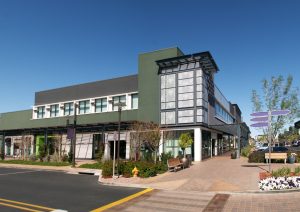
The physical work that creates value is the work that changes how tenants and customers experience the property. At Western Plaza, the case study describes a full redevelopment rather than a cosmetic update. The work covered the major building systems, including electrical, mechanical, water and gas, along with site regrading and a fully rebuilt parking lot with new lighting and landscaping. Storefronts were modernized with oversized glass and the center received new monument signage for visibility.
Trade press coverage of the sale describes the same program in summary form: a complete exterior facade modernization, upgraded building systems, parking lot enhancements and an improved tenant mix, according to Shopping Center Business. The pattern is clear. Systems and site work are not glamorous, but they remove objections that keep good tenants away. Our article on renovating shopping centers covers timing.
How does tenant merchandising shape a neighborhood center?
Merchandising shapes a neighborhood center by deciding who the daily customer is and which tenants serve that customer together. At Western Plaza, the leasing focus described in the case study was food, wellness and essential services, with a mix of national, regional and locally owned businesses that fit the local market.
Necessity driven and service oriented tenants give customers a reason to visit often, and those visits help neighboring tenants. Our investment thesis describes necessity based real estate as an asset class that has proven resilient against economic fluctuations. Cushman & Wakefield makes a related point in its coverage of the ICSC conference: success is increasingly defined by how well tenant mix drives traffic, engagement and long term performance. The practical lesson is that a leasing plan should be a mix plan, not a list of the first tenants who sign.
Why does outdoor space matter in a retail repositioning?
Outdoor space matters because it gives a center a place where customers stay, not just stop. The redevelopment at Western Plaza included a roughly 4,000 square foot outdoor dining plaza, as reported by Shopping Center Business.
The principle applies beyond one project. Converting underused space into something customers want can improve the experience for every tenant. It also raises a fair investor question: did the sponsor spend capital where the property was weakest, or where the drawings looked best?
How quickly can a repositioning move from acquisition to stabilization?
Timing depends on the property, the market and the scope of the work, so no single project sets a standard. The Western Plaza case study states that the center was stabilized and sold in under two years after the early 2024 acquisition. It is one data point about one project, not a forecast.
What investors can take from it is a way to look at schedule. Ask which tasks must happen in order, such as permits, systems work and site work before storefronts, and which can run together, such as leasing conversations during construction. A repositioning that depends on everything going right is a weak plan. Our guide to the new rules of retail leasing explains why early tenant conversations shape both design and timeline.
What can an investor apply when evaluating any repositioning?
An investor can apply five questions to any repositioning, whether the sponsor is West Hive Capital or someone else. First, what exactly is wrong with the property today, separated into physical, legal and leasing issues? Second, which dollars in the capital plan change tenant demand and which only change appearance? Third, what is the tenant mix the sponsor is aiming for, and why does it fit this trade area? Fourth, what is the sequence and what happens if one step slips? Fifth, what does the sponsor do if the plan stalls and the center needs more time?
These questions do not depend on a number from a past project. They test the quality of thinking. Our article on misconceptions about shopping center redevelopment lists several errors that careful questions can catch early.
What would an operator repeat and what would it change?
Operators should repeat the habits that made a project controllable and change the ones that made it fragile. We would repeat three principles. Start with the facts of the property, not the story. Fix the infrastructure that tenants cannot see before the finishes that customers can. Lease for a mix, with attention to which tenants strengthen each other.
We would also keep sharpening three others. Test the schedule against slower permits and longer lease negotiations. Document why each capital item exists. Tell partners early when a decision changes. These are general principles, and each project needs its own analysis. Past results do not predict future ones.
FAQ: What Can Investors Learn From a Retail Repositioning?
What was Western Plaza?
Western Plaza is a neighborhood retail center in Rancho Palos Verdes, California. West Hive Capital acquired it in early 2024, completed a redevelopment of the property and later sold it.
What was included in the Western Plaza renovation?
According to the West Hive Capital case study, the work included replacing major building systems, regrading the site, rebuilding the parking lot, modernizing storefronts and adding monument signage. Press coverage also reports a roughly 4,000 square foot outdoor dining plaza.
Does the Western Plaza result predict future West Hive Capital projects?
No. Each property has its own condition, market and tenant demand, and past results do not predict future performance. This article is educational and describes general principles only.
If you are a family office, co GP or accredited investor who wants to learn more about how West Hive Capital approaches neighborhood retail, connect with our team.
Sources & Further Reading
- West Hive Capital: Western Plaza Case Study
- Shopping Center Business: West Hive Capital Sells Western Plaza in Southern California
- REBusiness Online: West Hive Capital Sells Western Plaza Retail Center
- Cushman & Wakefield: Insights from ICSC on Tenant Remix
- West Hive Capital: Investment Thesis
- West Hive Capital: Our Approach
About the Author

Managing Partner, West Hive Capital
Brandon brings 20+ years of experience in retail real estate development and operations. He previously led projects with SCG West and oversaw the acquisition, renovation, and exit of Western Plaza in Rancho Palos Verdes. He focuses West Hive Capital on neighborhood strip centers in Southern California and metro Phoenix.
This article is for educational purposes only and is not an offer to sell or a solicitation of an offer to buy any security. Any offering is made only through confidential offering documents to qualified investors.