Last updated: October 19, 2026 · By Brandon Lehman, Managing Partner, West Hive Capital
Orange County’s retail landscape has defied expectations. While office and multifamily markets absorbed headline volatility, neighborhood and community retail in OC has quietly tightened — driven by the county’s high-barrier geography, wealthy suburban base, and relentless demand from service tenants who need physical storefronts to operate.
Key Takeaways
- OC retail availability hit 3.7% in Q2 2026 — the lowest on record, per CBRE.
- Strip center vacancy held 4.0–4.6% for more than five consecutive years, per Marcus & Millichap Q3 2026.
- Average OC cap rate: ~5.0% — well below the national average of 6.9% (MSCI via REBusiness Online).
For investors evaluating unanchored strip centers in Southern California, OC deserves a close look this quarter. Here’s what the data and deal flow are showing.
Why Orange County Retail Holds Its Ground
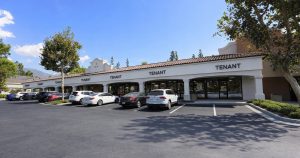
Orange County sits in an unusual position: it’s a coastal county with limited developable land, high household incomes, and a tenant base dominated by businesses that cannot work remotely — dental practices, urgent care clinics, specialty fitness, nail salons, dry cleaners, and food-and-beverage operators.
This “service retail” cluster is the same cohort that has kept unanchored strip centers full while power centers and big-box formats absorbed the e-commerce shock of the last decade. The trend is showing up in the numbers: CBRE’s Q2 2026 Orange County Retail Figures show availability falling to 3.7% — matching the market’s lowest recorded level — as net absorption reached 335,000 square feet in a single quarter.
The county’s median household income — well above state and national averages — supports the type of discretionary spending that keeps these tenants viable. That spending power is also why national franchise operators treat OC as a high-priority expansion market, creating steady inbound interest in available retail suites.
How Tight Is Orange County Strip Center Vacancy — and Where?
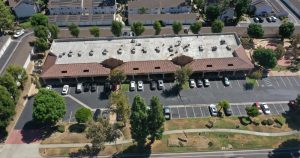
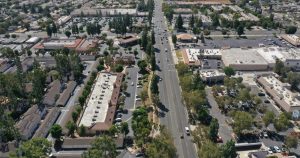
Strip center vacancy in Orange County has stayed compressed for years. Marcus & Millichap’s Q3 2026 Orange County Retail Market Report notes vacancy has held between 4.0% and 4.6% for more than five years, with the market expected to stay near the lower end of that range heading into Q4. That sustained tightness masks real submarket divergence — South County corridors (Laguna Niguel, Mission Viejo, San Clemente) and the Anaheim/Orange/Tustin triangle are among the tightest, while some Mid-County pockets carry more availability due to older vintage centers requiring repositioning capital.
| OC Submarket | Vacancy (est.) | Cap Rate Range | Investor Notes |
|---|---|---|---|
| South OC (Mission Viejo / San Clemente) | ~4.0% | 5.6–6.0% | High income, limited supply; prices are full |
| Anaheim / Orange / Tustin | ~4.5% | 5.8–6.1% | Older vintage = value-add optionality |
| Costa Mesa / Newport Beach | ~3.5% | 5.0–5.5% | Trophy locations; premium entry prices |
| East OC (Yorba Linda / Placentia) | ~5.0% | 6.0–6.5% | Overlooked; strong service-tenant demand |
Sources: Marcus & Millichap Q3 2026 OC Retail, CBRE Q2 2026, Matthews Q2 2026 LA Metro. Ranges are estimates based on published broker data.
That variance creates a real opportunity. Centers in need of moderate renovation — updated façades, improved parking flow, refreshed tenant mix — can be repositioned at current rents within 12–24 months if acquired at the right basis. A Commercial Observer analysis of H1 2026 SoCal retail investment data — citing NAI Capital — notes demand remained particularly strong for smaller, premium retail properties, exactly the profile where well-located value-add strip centers compete.
This is precisely the acquisition profile West Hive Capital focuses on. Our acquisition playbook details the screening criteria we apply when evaluating retail basis, lease structure, and tenant credit in these markets.
What Cap Rates Are OC Strip Centers Trading At in Q4 2026?
The compression story in OC strip retail has been real, but it has slowed. Per MSCI data cited by REBusiness Online, the average OC retail cap rate held at 5.0% through Q1 2026 — well below the Western U.S. average of 6.4% and the national average of 6.9%. Matthews’ Q2 2026 Los Angeles retail market report puts the broader metro-wide cap rate at 5.96%, with submarket readings ranging from 5.6% to 6.1% — a range consistent with what buyers are seeing in OC’s premium corridors.
The margin lives in execution: finding off-market or lightly marketed assets where price reflects current vacancies or lease rollover risk, rather than pro-forma stabilized rents. The buyers winning deals in OC today are not chasing stabilized product at listed prices. They are building relationships with owners directly and underwriting value-add scenarios invisible to yield-focused buyers.
For investors exploring SoCal retail, our investment thesis outlines how we think about basis, downside protection, and the risk-adjusted case for neighborhood retail specifically.
Which Orange County Submarkets Should Strip Center Investors Watch in Q4 2026?
1. South OC (Mission Viejo / San Clemente corridor): Limited new supply, high-income demographics, strong franchise demand. Prices are full but deals still trade for strategic buyers.
2. Anaheim / Orange triangle: Older vintage centers create value-add optionality. Proximity to the 57/91 interchange and Disneyland visitor economy supports retail volume.
3. Costa Mesa / Newport Beach adjacents: High rents, trophy locations. Better suited for well-capitalized buyers; entry prices reflect the premium.
4. East OC (Yorba Linda / Placentia): Frequently overlooked but exhibiting the tenant demand characteristics — suburban, income-stable, service-tenant heavy — that define durable strip center performance.
What the Rate Environment Means for OC Strip Deals
The Fed’s actions over the past two years have reset financing expectations for commercial real estate broadly. Our recent post on neighborhood retail’s quiet outperformance covers the macro backdrop in detail — including why service-anchored strip centers specifically have held occupancy through the rate cycle.
Rate stabilization has re-enabled deal velocity in the sub-$10M strip center space, and Orange County is one of the markets where that is most visible. SoCal retail investment dollar volume jumped 61.8% in H1 2026 to $3.52 billion, per Commercial Observer. Lenders who sat out 2023–2024 have re-entered with improved pricing on stabilized product.
How West Hive Capital Approaches OC
West Hive Capital’s acquisition focus includes Southern California retail, and Orange County fits within our core geographic scope. We look for centers in the $3M–$10M range where we can add value through lease-up, tenant repositioning, or physical improvements.
If you’re exploring strip center opportunities in OC — whether as a seller, a potential capital partner, or a co-investment interest — get in touch. We’re active, we’re direct, and we know the market.
Frequently asked questions
What makes Orange County strip centers attractive to investors in Q4 2026?
OC retail availability hit 3.7% in Q2 2026 — the lowest on record per CBRE — while vacancy has held between 4.0–4.6% for more than five years. Service-oriented tenants, high household incomes, and limited new supply create durable occupancy for well-located unanchored strip centers.
What are typical cap rates for strip centers in Orange County right now?
The average OC retail cap rate held at approximately 5.0% through Q1 2026, well below the Western U.S. average of 6.4% and the national average of 6.9%, per MSCI data. Value-add assets with vacancy or near-term lease rollover trade at wider spreads reflecting repositioning risk.
How do I evaluate whether an OC strip center is a good acquisition?
Key factors include submarket vacancy trends, in-place vs. market rent spread, tenant credit and lease term, physical condition, and purchase price relative to replacement cost. West Hive Capital’s acquisition playbook covers the screening framework in detail.
Sources & Further Reading
- CBRE — Orange County Retail Figures Q2 2026
- Marcus & Millichap — Orange County Retail Market Report Q3 2026
- Matthews Real Estate — Los Angeles Retail Market Q2 2026
- Commercial Observer — SoCal Retail Investment Jumps 62% in H1 2026
- REBusiness Online — Orange County Retail Is Hot, Summer 2026
- NAI Capital
About the Author

Managing Partner, West Hive Capital
Brandon brings 20+ years of experience in retail real estate development and operations. He previously led projects with SCG West and oversaw the acquisition, renovation, and exit of Western Plaza in Rancho Palos Verdes. He focuses West Hive Capital on neighborhood strip centers in Southern California and metro Phoenix.